There is a particular kind of pride that comes from grinding a big gear. You feel strong, planted, unstoppable, and for the first hour of a ride that feeling is mostly justified. The problem shows up at hour four, when your legs are hollowed out and the same gear that felt heroic in the morning now feels like pedalling through wet concrete. After enough long days in the saddle, I have become convinced that on rides measured in hours rather than minutes, how fast you spin the pedals matters more than how hard you push them.
What cadence actually is#
Cadence is simply your pedalling speed, measured in revolutions per minute (RPM). Spin the cranks around sixty times in a minute and you are at 60 RPM; do it ninety times and you are at 90.
Here is the piece riders often miss: the power you produce is a product of how hard you press and how fast you turn the cranks. That means you can produce the exact same wattage in two very different ways. You can push a huge gear slowly, loading each pedal stroke heavily, or you can push a smaller gear quickly with far less force per stroke. Same speed on the road, same power output, radically different experience for your body.
The mistake is treating those two approaches as interchangeable. They are not. They tax completely different systems, and over a long ride that difference compounds.
Where the fatigue actually comes from#
When you grind a big gear, each pedal stroke demands a large muscular contraction. You are recruiting a lot of muscle fibre, and specifically leaning hard on the fast-twitch fibres that produce force but tire quickly and burn through glycogen. Do that thousands of times over a long ride and you are essentially performing a slow, endless leg-press session. The failure point is local and muscular: your quads cook long before your heart and lungs are the limiting factor.
Spin a lighter gear faster and you flip the burden. Each individual stroke is gentler, so muscular strain per revolution drops. In exchange, your heart rate creeps up and you breathe a little harder, because you are asking your cardiovascular system to do more of the work.
That trade is the whole point. Your cardiovascular system recovers far better mid-ride than your leg muscles do. You can hold an elevated heart rate for hours. You cannot ask your quads to keep firing near-maximal contractions for hours without them shutting the party down. On a long ride, protecting your legs is the priority, and a higher cadence is the cheapest way to buy that protection.
The counterintuitive part#
New riders resist this because a higher cadence feels harder in the moment. Your breathing is heavier, your heart is thumping, and it seems obvious that heavier breathing equals more fatigue. But breathing hard is not the same as burning out. That cardiovascular effort is sustainable in a way that muscular grinding is not, and the leg-savings only reveal themselves later, when the grinder is fading and the spinner still has something left.
There is no single magic number#
You will read that 90 RPM is the "correct" cadence, usually because a famous rider from a past era favoured a rapid spin. Ignore the idea that one number is right for everyone. Your ideal self-selected cadence depends on your muscle composition, your fitness, the terrain, and simple habit.
What I can offer instead is a practical range and some honest caveats:
- Roughly 80–95 RPM on the flat suits most endurance riders well. It is high enough to spare the legs without spinning so fast you start bouncing.
- Grinding below about 60 RPM for long stretches on the flat is usually a sign you are under-geared or over-gunning it. Occasionally useful, rarely a good default.
- Spinning above 100 RPM for hours is not automatically better. Too fast and you waste energy on the internal work of moving your own legs, and you start rocking in the saddle, which is its own inefficiency.
The honest caveat: some strong, experienced riders are genuinely more efficient at a lower cadence, particularly time-triallists and big-geared rouleurs. If you have ridden for years at 75 RPM and finish long rides fresh, you do not need me to reorganise your legs. This advice is aimed at the far more common rider who defaults to a heavy gear because it feels powerful and then wonders why they blow up.
Cadence and gearing are the same conversation#
You do not control cadence directly. You control it through gear selection, which is why the two topics are inseparable. The whole skill is using your gears to keep your cadence in a comfortable band as the road changes.
On the climbs#
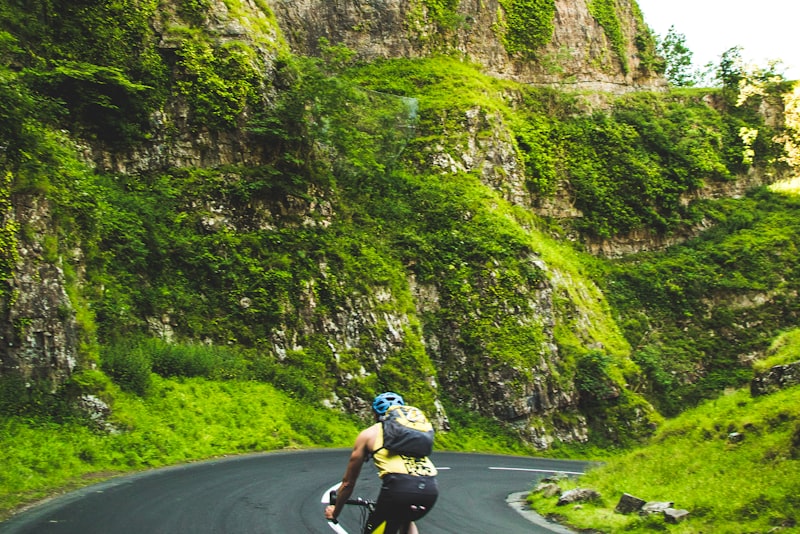
Climbs are where poor cadence discipline does the most damage. The gradient tips up, your speed drops, and if you leave the gear alone your cadence collapses. Suddenly you are doing heavy squats up the hill, torching your legs exactly when the ride is hardest.
The fix is unglamorous: shift earlier than you think you need to. As the road ramps, drop into an easier gear before your cadence sags, so you can keep spinning up the climb rather than lurching over it. On long or repeated climbs this is the difference between arriving at the top ready to keep working and arriving with your legs already spent.
This is also the strongest practical argument for gearing that many riders resist on ego grounds. A wider-range cassette or a compact chainset is not a sign of weakness. It is the equipment that lets you hold an efficient cadence on gradients where a racing setup would force you to grind. I would far rather see a rider on friendly gearing spinning up a climb than a rider on aggressive gearing wrestling it.
On the flats and descents#
On rolling terrain the same principle applies in miniature. Anticipate the little rises, shift down as the road tips up, shift back as it flattens, and try to keep the pedals turning at a steady rhythm rather than letting cadence yo-yo with every undulation. Smoothness is the goal. Every time you let cadence crater and then stamp to recover, you spend a little muscular capital you did not need to spend.
How to actually change your habit#
If you are a natural grinder, you cannot just decide to spin and expect it to feel good. A higher cadence feels ragged and inefficient at first because your neuromuscular coordination has not caught up. It takes practice to make a fast, smooth spin feel natural. A few things that genuinely work:
- Get a cadence readout. Most bike computers pair with a cheap magnet or accelerometer-based sensor, and many will estimate cadence without one. You cannot manage what you cannot see, and early on you will be shocked how often you drift back into a heavy gear.
- Do dedicated spin-ups. On a quiet stretch or a trainer, gradually raise your cadence over thirty seconds until you are just about to bounce in the saddle, then ease back to smoothness. Repeat. You are teaching your legs to fire quickly without wasted motion.
- Ride some intervals in an easier gear than feels natural. Deliberately pick a gear that forces 90-plus RPM at your normal effort and hold it. It will feel silly for a while. Then one day it feels like nothing.
- Focus on pulling your foot back through the bottom of the stroke, as if scraping mud off your shoe. It smooths out the dead spots and makes a quick cadence feel round rather than choppy.
Give it a few weeks of consistent attention. The window where spinning feels awkward is real but short, and on the other side of it an efficient cadence becomes your default rather than something you have to think about.
The caveats worth keeping#
I am not telling you power does not matter. It obviously does; you cannot spin an empty gear and expect to go fast. Cadence is not a substitute for fitness, it is a way of spending the fitness you have more wisely over a long day.
And there are moments where a big-gear grind is exactly right: a short, sharp effort where the ride is nearly over and you have no need to conserve, a punchy rise you can power over in seconds, a sprint. The argument here is specifically about the long haul, where the goal is to arrive at the end with something left. Over four, five, six hours, the rider who protected their legs with a smart cadence almost always finishes stronger than the rider who spent the day proving how big a gear they could push.
The takeaway#
Next long ride, try this. Pay attention to your cadence for the first hour, keep it a touch higher than feels natural, and shift early on every rise so the pedals never bog down. It will feel like you are working harder in your lungs and easier in your legs, and that is exactly the trade you want. The real reward comes late, in the final hour, when the grinders are counting down the miles and you still feel like riding. That is what cadence buys you: not speed for its own sake, but the ability to keep going.